Landlord Electrical Safety Guide
EICR and PAT Testing for London Rental Flats
When a rental flat in London is being prepared for a new tenancy, renewal, agent check-in or portfolio review, electrical safety paperwork must be clear, up to date and easy to manage. Working with a qualified Electrician in London helps landlords understand what needs to be inspected, what should be recorded and how to avoid last-minute delays before a tenant moves in.
EICR and PAT testing are often mentioned together, but they are not the same service. An Electrical Installation Condition Report checks the fixed wiring and electrical installation of the property. PAT testing focuses on portable or movable electrical appliances supplied for tenant use, such as white goods, lamps, kettles, microwaves and extension leads.
For London landlords, property managers and letting agents, arranging both checks in a planned way can reduce access problems, support better compliance records and give a wider view of electrical safety inside a rental flat.
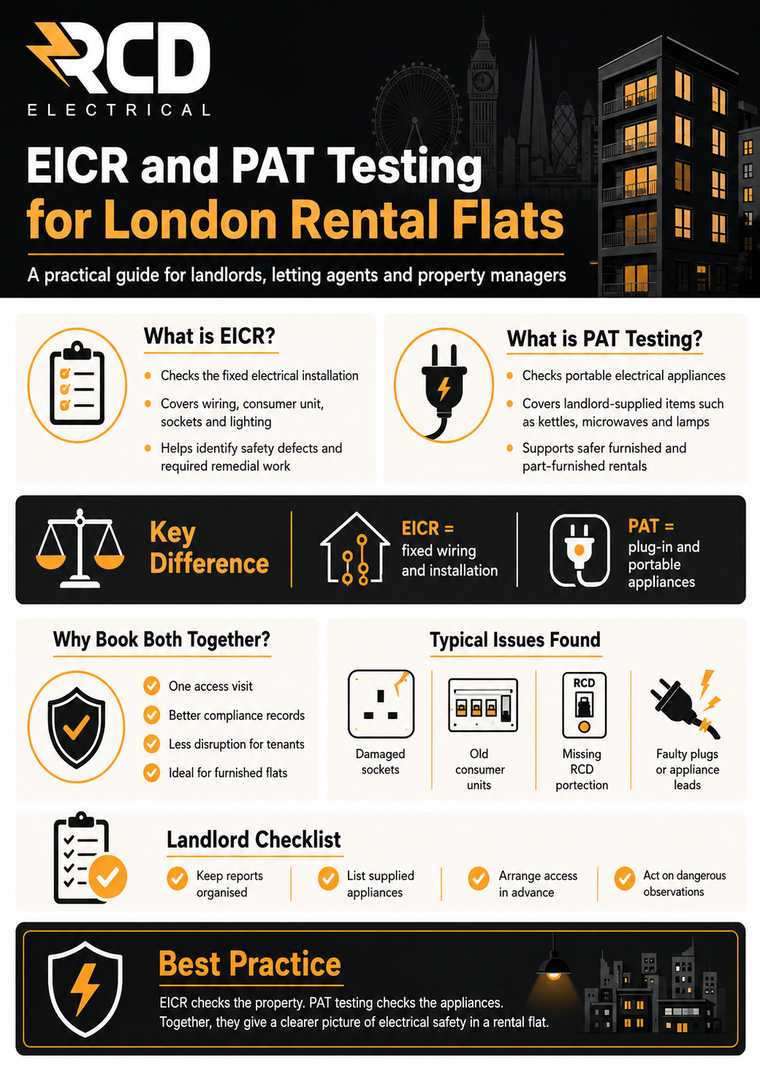
EICR and PAT Testing Infographic
This visual guide summarises the key difference between EICR and PAT testing, why landlords often book both together, and what should be prepared before testing a London rental flat.
 Click to enlarge
EICR vs PAT Testing: What Is the Difference?
An EICR, or Electrical Installation Condition Report, is a professional inspection and test of the fixed electrical installation in a property. This includes the consumer unit, wiring, circuits, sockets, switches, light points, protective devices, earthing and bonding. It is designed to assess whether the installation is safe for continued use.
PAT testing, or Portable Appliance Testing, is different. It relates to electrical equipment and appliances that can be moved, plugged in or supplied separately from the fixed wiring. In a furnished rental flat, this may include a fridge freezer, washing machine, microwave, kettle, toaster, TV, table lamp, vacuum cleaner or extension lead supplied by the landlord.
The simple way to remember the difference is this: an EICR checks the property’s electrical installation; PAT testing checks the appliances provided inside the property. One does not automatically replace the other.
| Service |
What It Checks |
Typical Rental Flat Examples |
| EICR |
Fixed electrical installation, wiring, circuits and protective devices. |
Consumer unit, sockets, lighting circuits, bathroom electrical points, earthing and bonding. |
| PAT Testing |
Portable, movable or landlord-supplied electrical appliances. |
White goods, microwaves, lamps, kettles, extension leads and plug-in equipment. |
| Combined Visit |
Both fixed installation safety and appliance safety records. |
Useful for furnished flats, managed lets, HMOs, serviced apartments and agent-managed properties. |
Landlord Electrical Duties in England
For rented homes in England, landlords must take electrical safety seriously. The fixed electrical installation must be inspected and tested by a qualified and competent person at the required interval, and the landlord must keep the report as part of the property’s safety records.
In practical terms, a landlord should make sure the EICR is valid, the report is available when needed, and any C1, C2 or FI observations are handled properly. A report with dangerous or potentially dangerous observations should not be treated as a simple paperwork issue. The required remedial work or further investigation should be arranged and documented.
PAT testing is often used as a structured way to check and record the condition of supplied appliances. Even where an agent or tenant has not specifically requested it, appliance safety can become important during check-in, renewal, inventory review, insurance queries and general property management.
If you are comparing inspection options, the guide to EICR Certificate Cost in London can help you understand the type of factors that usually affect pricing, including property size, number of circuits and inspection scope.
Important: EICR and PAT testing should be understood as two connected but separate safety records. A flat may pass appliance checks while still needing remedial work on the fixed installation.
Why London Landlords Often Book EICR and PAT Testing Together
London rental flats can be difficult to access. A tenant may only be available outside working hours, a concierge may need advance notice, keys may sit with an estate agent, and parking or loading rules can affect the appointment. In managed blocks, the engineer may also need building access instructions, flat numbers, lift information and contact details before arrival.
Booking EICR and PAT testing during the same visit helps reduce repeated access arrangements. The landlord or property manager can organise one appointment, one visit, one access window and one set of safety records. This is especially useful when the property is furnished, part-furnished, agent-managed or close to a new tenancy start date.
Same-visit testing can also prevent a common problem: the landlord books only an EICR, then later discovers that the letting agent also wants appliance safety evidence for supplied equipment. By that stage, the tenant move-in date may be close and arranging another visit can create unnecessary pressure.
- One access arrangement for the tenant, agent or concierge
- Less disruption for occupied rental flats
- Clearer records for fixed wiring and appliances
- Useful for furnished and part-furnished properties
- Fewer delays before tenancy start dates
- Better organisation for landlords with multiple flats
What an EICR Checks in a London Rental Flat
An EICR is a detailed inspection and test of the electrical installation. The electrician is looking for damage, deterioration, unsafe alterations, poor earthing, overloaded circuits, unsuitable accessories, missing protection and anything that may create a risk of electric shock, fire or injury.
In a typical London flat, the inspection may include checks on the consumer unit, circuit protection, socket outlets, light fittings, main earthing, bonding, polarity, continuity, insulation resistance and earth fault loop impedance. Bathroom and kitchen areas often need careful attention because they combine electrical equipment with moisture, heat and regular tenant use.
The report will usually classify observations using EICR codes. A C1 means danger is present and immediate action is needed. A C2 means potentially dangerous and remedial work is required. An FI means further investigation is required without delay. A C3 is an improvement recommendation and does not usually make the report unsatisfactory by itself.
Typical EICR issues found in rental flats
- Damaged or loose socket outlets
- Missing or inadequate RCD protection
- Old consumer units with safety concerns
- High earth fault loop impedance readings
- Poor circuit identification
- Unsuitable bathroom fittings
- Overheating signs at accessories or consumer units
- Unsafe DIY electrical alterations
If you need a professional EICR Certificate London service, it is important to choose an electrician who can explain the report clearly and guide you through the next step if remedial work is required.
What PAT Testing Covers in a Rental Property
PAT testing checks portable or movable electrical appliances and equipment. The process can include a visual inspection, plug and cable checks, earth continuity testing, insulation resistance testing and other appropriate appliance tests depending on the equipment type and condition.
Visual inspection is an important part of the process. Some defects are visible before any test instrument is used, such as cracked plugs, damaged flexes, loose cable grips, exposed insulation, scorch marks, broken casings or signs of overheating.
For furnished and part-furnished rental flats, the most common landlord-supplied items include white goods and daily-use appliances. These items can be moved, cleaned, pulled out, pushed back, overloaded or used heavily by tenants over time.
Appliances commonly included in landlord PAT testing
- Fridge freezer
- Washing machine
- Dishwasher
- Microwave
- Kettle and toaster
- Table lamps and floor lamps
- Portable heaters
- Extension leads and power adapters
If an appliance belongs to the tenant rather than the landlord, it should be identified separately. Clear ownership helps avoid confusion about what is included in the test and what is outside the landlord’s supplied inventory.
Why London Rental Flats Need a Careful Electrical Safety Approach
London flats are not all the same. Some are in modern developments with concierge access and managed plant rooms. Others are in converted houses, mansion blocks, older purpose-built buildings or period properties where the wiring has been altered many times over the years.
Because of this, electrical issues can vary widely. One flat may have a modern consumer unit and neatly labelled circuits, while another may have older accessories, poor circuit records, mixed wiring ages or previous additions that were not installed to a good standard.
Rental flats can also experience heavy appliance use. White goods may be used daily, moved during cleaning, installed tightly under kitchen worktops or hidden behind integrated panels. Where access is restricted, the engineer may only be able to test what can be safely reached without dismantling furniture or causing damage.
For landlords and agents, the aim is not just to collect certificates. The aim is to understand whether the property is electrically safe for continued occupation and whether any supplied appliances are suitable for tenant use.
EICR and PAT Testing Cost in London: What Affects the Quote?
The cost of EICR and PAT testing depends on several practical factors. An EICR is usually affected by the property size, number of bedrooms, number of circuits, condition of the installation and access to the consumer unit. PAT testing is usually affected by the number and type of appliances being checked.
A one-bedroom flat with clear access and a small number of supplied appliances will normally be simpler than a large furnished apartment with multiple appliances, integrated white goods and limited access. Parking, congestion charges, key collection and out-of-hours access can also affect the overall booking arrangement.
Landlords should be careful when comparing very low quotes. A cheap appointment may not include all appliances, proper reporting, access time, parking terms, remedial guidance or clear aftercare if the EICR is unsatisfactory. The better question is not only “What is the price?” but “What is included and what happens if something fails?”
Before accepting a quote, confirm:
- Whether the quote includes EICR only or EICR plus PAT testing
- How many appliances are included
- Whether white goods are accessible
- How reports or certificates will be provided
- Whether parking or congestion charges apply
- What happens if remedial work is required
Booking Checklist for Landlords, Agents and Property Managers
A smooth electrical safety visit depends on good information before the electrician attends. This is particularly important in London, where access arrangements can create more delays than the testing itself.
Before booking, the landlord or property manager should confirm the full address, flat number, building name, postcode, certificate name, access contact, tenant or concierge details, preferred appointment window and any parking instructions.
If PAT testing is required, prepare a list of landlord-supplied appliances. If the flat is furnished, make clear whether lamps, extension leads, kitchen appliances or portable heaters should be included. If white goods are integrated or difficult to reach, this should be discussed at the booking stage.
- Full property address and postcode
- Flat number and building access details
- Tenant, agent or concierge contact
- Certificate name required on the report
- Number of bedrooms and property type
- List of appliances for PAT testing
- Parking, loading or congestion charge information
- Any known electrical issues or previous reports
Tip: If the property is occupied, tell the tenant that power may need to be switched off temporarily during parts of the EICR testing process.
What Happens After the EICR and PAT Testing Visit?
After the visit, the landlord or property manager should receive the relevant report or certificate information. If the EICR is satisfactory, the report can be kept with the tenancy and compliance records until the next inspection is due.
If the EICR is unsatisfactory, the observations should be reviewed carefully. C1, C2 and FI items require proper action. Remedial work or further investigation should be arranged, completed and documented so the landlord has evidence that the issue has been addressed.
If an appliance fails PAT testing, the usual options are repair, replacement or removal from use, depending on the type of defect and whether repair is sensible. A failed appliance does not automatically mean the fixed installation has failed, and an unsatisfactory EICR does not automatically mean every appliance is unsafe. Each record should be considered separately.
This is why combined testing is useful. It gives a clearer picture of both the fixed electrical installation and the supplied appliances, without confusing the two.
When Should a Landlord Book EICR and PAT Testing?
The best time to book is before the paperwork becomes urgent. For a new tenancy, arrange testing before the tenant moves in. For an occupied rental, plan the appointment with enough notice for tenant access. For a furnished flat, confirm the appliance list early so PAT testing can be included during the same visit.
Landlords should also consider testing when taking over a property, preparing a flat for market, renewing management records, dealing with agent requests or responding to electrical concerns raised by tenants.
Where there are warning signs such as repeated tripping, burning smells, damaged sockets, warm plugs, flickering lights or unexplained power loss, the issue should be treated as a safety concern rather than a routine certificate booking.
Need EICR and PAT Testing for a London Rental Flat?
RCD Electrical helps landlords, letting agents and property managers arrange professional electrical testing for rental flats across London. We can help with EICR inspections, appliance testing, fault finding and remedial electrical work where required.
Speak to our experienced London Electricians if you need clear advice, safe testing and practical support before a tenancy, renewal or property management deadline.